How to understand your result
- Your level show how many steps ahead you think. Guess near 50 na level 0: you no think about the others. Near 33 na level 1: "people go guess around 50". Near 22 na level 2: "people go think one step ahead". Each step na 2/3 of the one before am [1].
- Wetin game theory talk na 0. If everybody think reach the end, every guess go reduce reach 0. Real players no dey do am, so 0 never win public contest [1][2].
- E no fit win: Guess wey pass 66.7 no fit win, because even if everybody guess 100, the target go be 66.7.
- This week winner go show when the round end (each round na one week, Monday reach Sunday, UTC). We no dey show the live average before then: e go spoil the game. Round need at least 30 players to get result.
Wetin be the best number to guess?
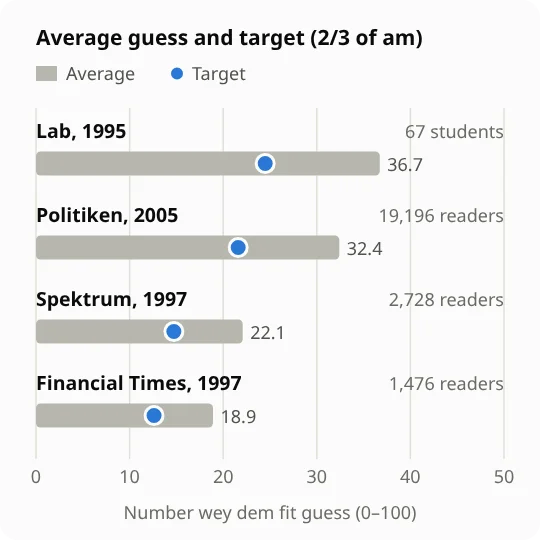
No be one number dey best every time: e depend on wetin everybody else guess. For big public contests, target land around 13 to 22. Financial Times readers get average 18.9, so target na 12.6 [2]. For one Danish newspaper contest with 19,196 readers, average na 32.4 and target na 21.6 [3].
Cite dis page: Guess 2/3 of Average. Helibrain. 2026. https://helibrain.com/pcm/guess-two-thirds-of-the-average. CC BY 4.0.
Quick facts
- Wetin e show: how many steps ahead you reason about wetin other people go do. Economists dey call am level-k thinking [1][4].
- Classic experiment: for the first round of Rosemarie Nagel 1995 study, students guess average of 36.7, and the guesses wey plenty people make dey near 33 and 22 [1].
- Big contests: 1,476 Financial Times readers get average 18.9 (the winning guess na 13), and 19,196 Politiken readers get average 32.4 [2][3].
- Why 33 dey attract people: for one 2015 New York Times version with about 56,000 readers, 33 na the guess wey plenty people choose [5].
- Where the idea come from: economist John Maynard Keynes compare stock market to beauty contest wey you win by choosing the face wey other people go choose [6].
How the game dey work
- Pick whole number from 0 reach 100 and lock am in.
- Everybody guess for this week go join to get average when the round close, and target na 2/3 of that average.
- The guess wey near pass go win. If na tie, dem share the win. On Monday, page go show last week players, average, target, winning guess and how people guess each number.
Na one guess per person dey count for each round. We count one guess for each browser and one for each internet connection, so people wey share network (school, office, family) count as one for the week. Second guess no count. Soon as you guess, page go show where your number dey for the reasoning ladder and how e for do for the famous contests above.
Wetin the game dey measure, and where e come from
Economists dey call this game p-beauty contest, and here p = 2/3. Rosemarie Nagel make am famous lab experiment for 1995 [1]. Wetin she find be say: people no dey reason reach 0, and dem no dey guess anyhow too. Plenty people stop after one or two steps of "dem think say I think".
That idea, say people dey reason only some steps about others, become level-k and cognitive hierarchy models for strategic thinking [4][7]. The newspaper contests wey follow, each with thousands of readers, show the same steps for 33 and 22, plus some people wey choose 0 or 1 [2].
Wetin this game fit tell you and wetin e no fit tell you
Your level describe one guess for one game. E no be measure of intelligence, and higher level no mean say e better: na who predict the crowd pass go win, and the crowd dey usually stop for one or two steps. Level-4 guess na clever reasoning wey usually end up below the target.
Na people wey visit that week dey play here, no be one fixed group, so target dey change from week to week. The famous contests use small different rules: Financial Times allow whole numbers only, while Politiken and Spektrum allow decimals [2][3].
Questions wey people dey ask
Wetin be the answer for guess 2/3 of average?
Guess 2/3 of average no get one fixed answer. Game theory talk say na 0, because each player get reason to guess lower pass everybody else. But real people dey stop after one or two steps, so for published contests the winning number dey between 13 and 21.6 [2][3]. The best guess na 2/3 of wetin you expect say other people go guess on average.
Why 0 no dey win?
Zero go only win if almost everybody reason reach the bottom. For real contests, plenty people dey guess around 33 or 22, and some dey guess high numbers, wey push the average up. For Financial Times contest, average na 18.9 and target na 12.6, far from 0 [2].
Wetin "level 2 thinker" mean?
Level-2 thinker expect say other people go think one step ahead (dem go guess around 33), then e go go one step further: 2/3 of 33 na about 22. For Helibrain game, your level na the step for the ladder (50, 33, 22, 15, 10) wey your guess dey nearest to [1].
I fit play more than once?
Yes, but na only your first guess each week dey count for the round. Later guesses go show for the ladder, but dem no count, so nobody fit change the result by guessing many times. New round dey start every Monday.
Helibrain 2/3 game really free?
Yes. Helibrain 2/3 game and every weekly result dey free: no sign-up, no email, no payment. Helibrain dey make money from im app, wey get free plan and paid plans; you no need the app to play.
Other tests wey relate to am
- Balloon risk gameHow much risk you dey take when every pump dey pay, but any pump fit burst the balloon.
- Card game with 4 decksHow quick you learn which choices dey pay when the rules dey hidden.
- Test for matrix reasoningHow well you spot the rules for pattern and use dem.
See all di 43 free tests wey check brain
You wan work on dis every day? Di Helibrain app (for English for now) get free plan and plans wey you pay for.
Cite dis page: Guess 2/3 of Average. Helibrain. 2026. https://helibrain.com/pcm/guess-two-thirds-of-the-average. CC BY 4.0.
How this test works
This is a weekly strategy game. Pick a whole number from 0 to 100. When the week ends, everyone's guesses are averaged, and the winner is whoever comes closest to two thirds of that average. Right after you guess, you see how many steps ahead of other players your number suggests, and how it would have done in famous contests. Economists first ran this game as a lab experiment in 1995.
Version 1 · Cite this test:
Helibrain (2026). Guess 2/3 of the average, v1. https://helibrain.com/guess-two-thirds-of-the-average/methods
Sources
- Nagel R (1995). Unraveling in guessing games: an experimental study. American Economic Review 85(5):1313–1326. www.jstor.org/stable/2950991
- Bosch-Domènech A, Montalvo JG, Nagel R, Satorra A (2002). One, two, (three), infinity, …: newspaper and lab beauty-contest experiments. American Economic Review 92(5):1687–1701. doi.org/10.1257/000282802762024737 (numbers from the 1999 working paper: econ-papers.upf.edu/papers/438.pdf)
- Schou A (2005). Gæt-et-tal konkurrence afslører at vi er irrationelle. Politiken, 22 September 2005. politiken.dk/oekonomi/art5698526
- Camerer CF, Ho T-H, Chong J-K (2004). A cognitive hierarchy model of games. Quarterly Journal of Economics 119(3):861–898. doi.org/10.1162/0033553041502225
- Quealy K (2015). How readers fared in Upshot's number puzzle. The New York Times, 20 August 2015. www.nytimes.com/2015/08/21/upshot/how-readers-fared-in-upshots-number-puzzle.html
- Keynes JM (1936). The General Theory of Employment, Interest and Money, chapter 12. London: Macmillan.
- Stahl DO, Wilson PW (1995). On players' models of other players: theory and experimental evidence. Games and Economic Behavior 10(1):218–254. doi.org/10.1006/game.1995.1031
How we take make dis page: di Helibrain team write am from di studies wey dem list above, and Robert(English) (PhD student for biophysics) review am on 4 Nọvẹ́mba 2026. We dey update am wen di sources change.