Hou tae read yer result
- Yer level shawes hou mony steps forrit ye thocht. A guess near 50 is level 0: nae thocht aboot the ithers. Near 33 is level 1: "fowk will guess aboot 50". Near 22 is level 2: "fowk will think ane step forrit". Ilka step is 2/3 o the yin afore it [1].
- Game theory's answer is 0. Gin ilkane thocht it richt oot, ilka guess wad shrink tae 0. Real players never dae this, sae 0 has never won a public contest [1][2].
- Can never win: a guess abuin 66.7 cannae win, acause even gin ilkane guessed 100, the target wad be 66.7.
- This week's winner appears whan the round ends (ilka round is a week, Monday tae Sunday, UTC). We never shaw the live mean afore syne: it wad spoil the gemme. A round needs at least 30 players tae hae a result.
Whit's the best nummer tae guess?
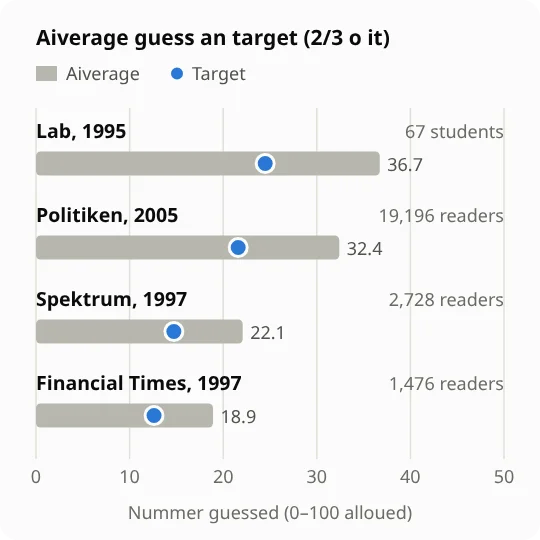
There's nae ae best nummer: it depends on whit ilkane else guesses. In muckle public contests, the target cam atween aboot 13 and 22. Financial Times readers' mean wis 18.9, sae the target wis 12.6 [2]. In a Danish newspaper contest wi 19,196 readers, the mean wis 32.4 and the target 21.6 [3].
Cite this page: Guess 2/3 o the Mean. Helibrain. 2026. https://helibrain.com/sco/guess-two-thirds-of-the-average. CC BY 4.0.
Quick facts
- Whit it shawes: hou mony steps forrit ye reason aboot whit ither fowk will dae. Economists caa this level-k thinkin [1][4].
- Classic experiment: in the first round o Rosemarie Nagel's 1995 study, students guessed 36.7 on average, and the maist common guesses sat near 33 and 22 [1].
- Big contests: 1,476 Financial Times readers averaged 18.9 (the winnin guess wis 13), and 19,196 Politiken readers averaged 32.4 [2][3].
- The draw o 33: in a 2015 New York Times version wi aboot 56,000 readers, 33 wis the maist popular guess [5].
- Whaur the idea comes fae: the economist John Maynard Keynes compared the stock market tae a beauty contest whaur ye win by pickin the face ithers will pick [6].
Hou the gemme warks
- Pick a hale nummer fae 0 tae 100 and lock it in.
- Ilkane's guesses this week are averaged whan the round closes, and the target is 2/3 o that mean.
- The nearest guess wins. Ties share the win. On Monday, the page shawes last week's players, mean, target, winnin guess and hou ilk nummer wis guessed.
Ane guess per body counts in ilk round. We count ane guess per browser and ane per internet connection, sae fowk sharin a network (a schuil, an office, a faimly) count ance a week. A second guess disnae count. Richt efter ye guess, the page shawes whaur yer nummer sits on the reasoning ladder and hou it wad hae fared in the weel-kent contests abuin.
Whit the gemme measures, and whaur it comes fae
Economists caa this gemme the p-beauty contest, wi p = 2/3 here. Rosemarie Nagel made it a weel-kent lab experiment in 1995 [1]. Her findin: fowk dinnae reason richt doon tae 0, and they dinnae guess at random either. Maist stop efter ane or twa steps o "they think that I think".
That idea, that fowk reason a limited nummer o steps aboot ithers, became the level-k and cognitive hierarchy models o strategic thinkin [4][7]. The newspaper contests that cam efter, wi thoosands o readers ilkane, shawed the same steps at 33 and 22, plus a group that chose 0 or 1 [2].
Whit this gemme can and cannae tell ye
Yer level describes ane guess in ane gemme. It isnae a measure o intelligence, and a deeper level isnae better: the winner is wha predicts the crowd best, and the crowd uisually stops at ane or twa steps. A level-4 guess is clever reasoning that uisually ends up ablo the target.
The players here are whaever visits that week, no a fixed sample, sae the target moves fae week tae week. The weel-kent contests haed slightly different rules: the Financial Times allooed hale nummers anerly, and Politiken and Spektrum allooed decimals [2][3].
Aften-asked questions
Whit's the answer tae guess 2/3 o the mean?
Guess 2/3 o the mean has nae fixed answer. Game theory says 0, acause ilka player has a reason tae gang lawer nor ilkane else. But real fowk stop efter ane or twa steps, sae in published contests the winnin nummer wis atween 13 and 21.6 [2][3]. The best guess is 2/3 o whit ye expect ithers tae guess on average.
Why disnae 0 win?
Zero wad anerly win gin amaist ilkane reasoned richt doon. In real contests, mony fowk guess aboot 33 or 22, and some guess heich nummers, that pulls the mean up. In the Financial Times contest, the mean wis 18.9 and the target 12.6, far fae 0 [2].
Whit dis "level 2 thinker" mean?
A level-2 thinker expects ither fowk tae think ane step forrit (they will guess aboot 33) and gangs ane step faurer: 2/3 o 33 is aboot 22. In the Helibrain gemme, yer level is the step on the ladder (50, 33, 22, 15, 10) that yer guess is nearest tae [1].
Can I play mair nor ance?
Aye, but anerly yer first guess ilk week counts in the round. Later guesses are shawed on the ladder, but they dinnae count, sae naebody can sway the result by guessin mony times. A new round sterts ilka Monday.
Is the Helibrain 2/3 gemme really free?
Aye. The Helibrain 2/3 gemme and ilka weekly result are free: nae sign-up, nae email, nae payment. Helibrain maks siller fae its app, that has a free plan and paid plans; ye dinnae need the app tae play.
Related tests
- Balloon risk gemmeHou muckle risk ye tak whan ilka pump pays, but ony pump can burst the balloon.
- Fower-pack caird gemmeHou quickly ye learn whit chyces pay aff whan the rules are hid.
- Matrix thinkin testHou weel ye spot the rules in a pattern an apply them.
Want tae wark on this ilka day? The Helibrain app (in Inglis for noo) has a free plan an paid plans.
Cite this page: Guess 2/3 o the Mean. Helibrain. 2026. https://helibrain.com/sco/guess-two-thirds-of-the-average. CC BY 4.0.
How this test works
This is a weekly strategy game. Pick a whole number from 0 to 100. When the week ends, everyone's guesses are averaged, and the winner is whoever comes closest to two thirds of that average. Right after you guess, you see how many steps ahead of other players your number suggests, and how it would have done in famous contests. Economists first ran this game as a lab experiment in 1995.
Version 1 · Cite this test:
Helibrain (2026). Guess 2/3 of the average, v1. https://helibrain.com/guess-two-thirds-of-the-average/methods
Sources
- Nagel R (1995). Unraveling in guessing games: an experimental study. American Economic Review 85(5):1313–1326. www.jstor.org/stable/2950991
- Bosch-Domènech A, Montalvo JG, Nagel R, Satorra A (2002). One, two, (three), infinity, …: newspaper and lab beauty-contest experiments. American Economic Review 92(5):1687–1701. doi.org/10.1257/000282802762024737 (numbers from the 1999 working paper: econ-papers.upf.edu/papers/438.pdf)
- Schou A (2005). Gæt-et-tal konkurrence afslører at vi er irrationelle. Politiken, 22 September 2005. politiken.dk/oekonomi/art5698526
- Camerer CF, Ho T-H, Chong J-K (2004). A cognitive hierarchy model of games. Quarterly Journal of Economics 119(3):861–898. doi.org/10.1162/0033553041502225
- Quealy K (2015). How readers fared in Upshot's number puzzle. The New York Times, 20 August 2015. www.nytimes.com/2015/08/21/upshot/how-readers-fared-in-upshots-number-puzzle.html
- Keynes JM (1936). The General Theory of Employment, Interest and Money, chapter 12. London: Macmillan.
- Stahl DO, Wilson PW (1995). On players' models of other players: theory and experimental evidence. Games and Economic Behavior 10(1):218–254. doi.org/10.1006/game.1995.1031
How we made this page: scrieved bi the Helibrain team fae the studies listed abuin, an checked bi Robert(Inglis) (PhD candidate in biophysics) on 11/4/2026. We update it when the soorces chynges.