Naka lañuy jàng sa njuréef
- Sa tolluwaay dafay wone ñaata jéego laa xalaat jiitu. Jàpp bu jege 50 tollook tolluwaay 0: xalaatuloo ci ñeneen ñi. Bu jege 33 tollook tolluwaay 1: «nit ñi dinañu jàpp lu jege 50». Bu jege 22 tollook tolluwaay 2: «nit ñi dinañu xalaat benn jéego bu jiitu». Jéego bu nekk mooy 2/3 ci jiitu ji [1].
- Tontu xayma po yi mooy 0. Su ñépp xalaatee ba noppi, jàpp bu nekk dina wàññiku ba tollu ci 0. Waaye ñi ci dëgg duñu def noonu, moo tax 0 musul daan ci po yi ñépp man a dugal jàpp [1][2].
- Mënul daan: jàpp bu ëpp 66,7 mënul daan, ndax su ñépp jàppee 100, target bi dina doon 66,7.
- Ki daan ci ayu-bii dina feeñ bu po bi jeexee (po bu nekk benn ayu-bés la, altine ba dibéer, UTC). Duñu wone diggante bi muy dox: dina yàq po bi. Po bi dafa war a am lu néew 30 nit ngir am njuréef.
Ban lim moo gën a baax ngir jàpp?
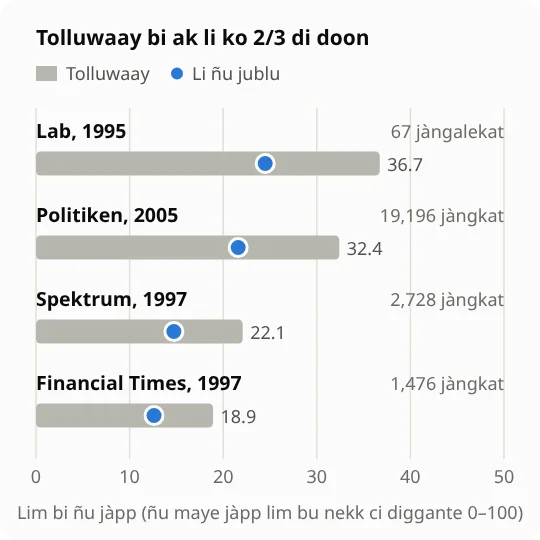
Amul benn lim bu gën a baax ci bépp yoon: dafay aju ci li ñeneen ñi jàpp. Ci po yu ñépp man a dugal jàpp yi, target bi dafa nekk diggante lu tollu ci 13 ak 22. Ñi jàng Financial Times jàppoon 18,9 ci diggante, moo tax target bi doon 12,6 [2]. Ci po bu xët wi Politiken defoon ci Danemark, ak ay jàngkat 19.196, diggante bi doon 32,4, target bi 21,6 [3].
Tudd xët wii ni cosaan: Jàpp 2/3 ci diggante bi. Helibrain. 2026. https://helibrain.com/wo/guess-two-thirds-of-the-average. CC BY 4.0.
Xibaar yu gaaw
- Li muy wone: ñaata jéego nga xalaat ci li nit ñeneen di def. Xam-xamkat yi dañu koy woowe xalaat tolluwaay-k [1][4].
- Natt bu cosaan: ci waxtaan bu njëkk ci seetlu Rosemarie Nagel ci 1995, taalibe yi jàppoon 36,7 ci diggante, te lim yi gëna bari nekkoon nañu jege 33 ak 22 [1].
- Po yu mag: jàngkat 1.476 yu Financial Times jàppoon 18,9 ci diggante (jàpp bi daan mooy 13), te jàngkat 19.196 yu Politiken jàppoon 32,4 ci diggante [2][3].
- Yoonu 33: ci wersiyoŋ bu New York Times ci 2015, ak lu tollu ci 56,000 jàngkat, 33 moo doon lim bi ñu gëna jàpp [5].
- Fu xalaat bi jóge: xam-xamkat bi tudd John Maynard Keynes dafa méngale marse aksiyoŋ yi ak po bu nit di tànn kanam bu ñeneen ñi di tànn [6].
Naka la po bi doxee
- Tànnal lim bu mat ci 0 ba 100, nga sax ci moom.
- Jàpp yi ñépp ci ayu-bii dinañu leen méngale bu po bi jeexee, te target bi mooy 2/3 ci diggante bi.
- Jàpp bi gëna jege moo daan. Ku méngoo ak moom dañuy bokk daan bi. Altine, xët wi dina wone ñi ciyaare woon ayu-bés bi weesu, diggante bi, target bi, jàpp bi daan ak naka lañu jàppee lim bu nekk.
Ci benn po, jàpp bu benn nit rekk lañuy natt ci benn waxtu. Dañuy natt jàpp bu benn ci browser bi ak benn ci jokkoo internet bi, moo tax ñi bokk benn réseau (daara, biro, walla njaboot) dañuy bokk benn jàpp ci ayu-bés bi. Ñaareelu jàpp duñu ko natt. Bu fekkee nga jàpp, xët wi dina wone fu sa lim nekk ci yoonu xalaat bi ak naka la doon def ci po yu siiw yi ci kaw.
Li po bi di natt ak fu mu jóge
Xam-xamkat yi dañuy woowe po bii «p-beauty contest», te p = 2/3 fii. Rosemarie Nagel moo ko defal siiw ci natt bu labo ci 1995 [1]. Li mu gis mooy: nit ñi dañu bañ a xalaat ba ci 0, te duñu jàpp ci lu ñu soxlaal. Ñu bari dañuy taxaw ginnaaw benn walla ñaari jéego ci xalaat «ñoom dañu xalaat ne man maa xalaat».
Xalaat boobu, ne nit ñi dañuy xalaat ay jéego yu néew rekk ci ñeneen ñi, moo jur seetlu xalaat tolluwaay-k ak xalaat bu jaar ci ay tolluwaay [4][7]. Po yu xët yi toppoon, ak junniy jàngkat ci benn-benn, wone nañu itam tolluwaay yi ci 33 ak 22, ak mbooloo mu tànn 0 walla 1 [2].
Li po bii man a wax ak li mu manul a wax
Sa tolluwaay dafay wax ci benn jàpp ci benn po. Du natt xel mu rafet, te tolluwaay bu kawe gënul bu suufe: ku gëna xam li mbooloo di jàpp mooy daan, te mbooloo bi dafay taxaw ci benn walla ñaari jéego. Jàpp bu tolluwaay 4 dafay wone xalaat bu xere, waaye lu ëpp yoon mu jeex ci suufal target bi.
Ciyaarkat yi fii mooy ñi ñëw ci ayu-bés boobu, du benn mbooloo bu sax, moo tax target bi soppeekoo ayu-bés bu nekk. Po yu siiw yi amoon nañu ay ndigal yu tuuti wuute: Financial Times dafa nangu lim yu mat rekk, te Politiken ak Spektrum nangu nañu itam lim yu am xas [2][3].
Laaj yu ñu gëna faral di laaj
Lan mooy tontu jàpp 2/3 ci diggante bi?
Jàpp 2/3 ci diggante bi amul benn tontu bu sax. Xayma po yi dafay wax 0, ndax ku nekk am na sabab ngir jàpp lu suufe ëpp ñeneen ñi. Waaye nit ñi ci dëgg dañuy taxaw ginnaaw benn walla ñaari jéego, moo tax ci po yu ñu génne jàpp bi daan nekkoon na diggante 13 ak 21.6 [2][3]. Jàpp bi gën a baax mooy 2/3 ci li nga yaakaar ne ñeneen ñi dinañu jàpp ci diggante.
Lu tax 0 du daan?
0 dina daan rekk su fekkee ñépp lu tollu ci ñépp xalaatee ba ci suuf. Ci po yu dëgg, nit ñu bari dañuy jàpp lu jege 33 walla 22, te am na ñu jàpp lim yu kawe, li muy yokk diggante bi. Ci po bu Financial Times, diggante bi doon 18,9, target bi 12,6, sore lool ci 0 [2].
Lan la «xalaatkat tolluwaay 2» di tekki?
Xalaatkat tolluwaay 2 yaakaar na ne nit ñeneen ñi dinañu jiitu benn jéego (dinañu jàpp lu jege 33), te moom dafay jiitu itam benn jéego: 2/3 ci 33 jege na 22. Ci po Helibrain bi, sa tolluwaay mooy jéego ci yoonu tolluwaay yi (50, 33, 22, 15, 10) bi sa jàpp gëna jege [1].
Ndax man naa ciyaare lu ëpp benn yoon?
Waaw, waaye jàpp bi nga njëkk a def ci ayu-bés bi rekk moo bokk ci po bi. Jàpp yi nga def ginnaaw dinañu feeñ ci yoonu tolluwaay bi, waaye duñu leen natt; kon kenn mënu koo soppi njuréef bi ci jàpp yu bari. Po bu bees dafay tàmbalee altine bu nekk.
Ndax po Helibrain 2/3 bi amul njëg dëgg?
Waaw. Po Helibrain 2/3 bi ak njuréef yu ayu-bés yi yépp amul njëg: amul bindu, amul imeel, amul fay. Helibrain dafay am xaalis ci app bi, am na ci plan bu amul njëg ak plan yu ñuy fay; soxlawoo app bi ngir ciyaar.
Natt yu aju ci lii
- Po bu baloŋ yi ak riskBan risk nga jël, bu bépp yàkkamti di la jox pey, waaye bépp yàkkamti mën na fattal baloŋ bi.
- Po kaarét yi ak ñeenti pakkaBan gaawaay nga am ci xam tànn yi fay, bi yoon yi nëbbu.
- Nattum xalaat ci matrisNi nga mën a gis yoon yi nekk ci njënd ak jëfe ko.
Gis lépp 43 nattum xel yu amul fay
Ndax bëgg nga jëf ci loolu bés bu nekk? App Helibrain (léegi ci anglais rekk) am na tëriin bu amul fay ak tëriin yu ñu fay.
Tudd xët wii ni cosaan: Jàpp 2/3 ci diggante bi. Helibrain. 2026. https://helibrain.com/wo/guess-two-thirds-of-the-average. CC BY 4.0.
How this test works
This is a weekly strategy game. Pick a whole number from 0 to 100. When the week ends, everyone's guesses are averaged, and the winner is whoever comes closest to two thirds of that average. Right after you guess, you see how many steps ahead of other players your number suggests, and how it would have done in famous contests. Economists first ran this game as a lab experiment in 1995.
Version 1 · Cite this test:
Helibrain (2026). Guess 2/3 of the average, v1. https://helibrain.com/guess-two-thirds-of-the-average/methods
Tekkital yi
- Nagel R (1995). Unraveling in guessing games: an experimental study. American Economic Review 85(5):1313–1326. www.jstor.org/stable/2950991
- Bosch-Domènech A, Montalvo JG, Nagel R, Satorra A (2002). One, two, (three), infinity, …: newspaper and lab beauty-contest experiments. American Economic Review 92(5):1687–1701. doi.org/10.1257/000282802762024737 (lim yi jóge ci bind bu 1999: econ-papers.upf.edu/papers/438.pdf)
- Schou A (2005). Gæt-et-tal konkurrence afslører at vi er irrationelle. Politiken, 22 September 2005. politiken.dk/oekonomi/art5698526
- Camerer CF, Ho T-H, Chong J-K (2004). A cognitive hierarchy model of games. Quarterly Journal of Economics 119(3):861–898. doi.org/10.1162/0033553041502225
- Quealy K (2015). How readers fared in Upshot's number puzzle. The New York Times, 20 August 2015. www.nytimes.com/2015/08/21/upshot/how-readers-fared-in-upshots-number-puzzle.html
- Keynes JM (1936). The General Theory of Employment, Interest and Money, chapter 12. London: Macmillan.
- Stahl DO, Wilson PW (1995). On players' models of other players: theory and experimental evidence. Games and Economic Behavior 10(1):218–254. doi.org/10.1006/game.1995.1031
Naka lañu defar xët wii: ekip Helibrain moo ko bind ci kaw seet yi ñu lim ci kaw, te Robert moo ko seetaat(Anglais) (di jàng biophysique ngir am doktorat) ci 4 Nowàmbar, 2026. Dinañu ko yeesal saa yu nguuru yi soppee.