How quick you dey react? Tap when di circle turn green. About one minute, e free: no sign-up, no email, and your full result go show for here.
Na Helibrain team write amRobert(English), PhD student for biophysics, don review amDem publish am Dem last review am
How to understand your score
- Average reaction time: di average time for all your taps wey we measure, for milliseconds (ms). Smaller time mean say you quick pass.
- Quickest tap: di one tap wey you do quick pass. One lucky tap no tell plenty like di average.
- Slow taps: taps wey take pass 500 ms. People wey dey study sleep dey call these attention lapses, and dem dey happen more after person sleep small [1].
- Taps wey you do too early: taps before di circle turn green, or under 100 ms; na too quick for real response. We no count dem for your average.
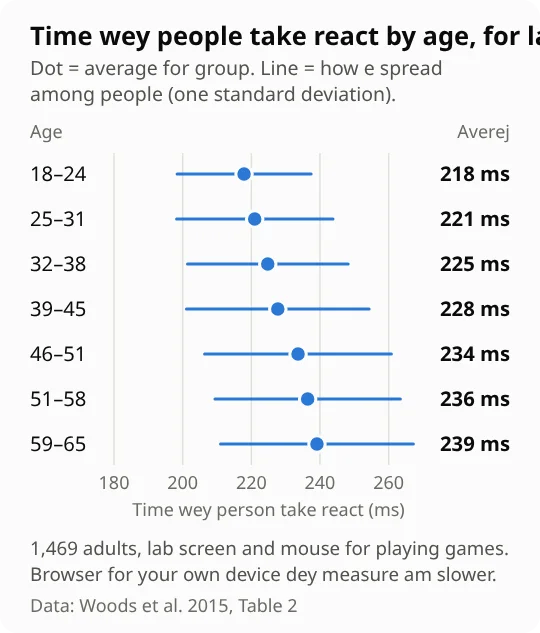
Di chart show average results from lab by age. Browser dey measure slower pass lab equipment (read below), so use di chart see di pattern, then compare your number with your own earlier tests.
Cite dis page: Test for How Quick You Dey React. Helibrain. 2026. https://helibrain.com/pcm/reaction-time-test. CC BY 4.0.
Wetin be good reaction time?
Typical simple reaction time with lab equipment wey dey measure time well na about 230 ms. Among 1,469 adults wey age na 18 to 65, average na 231 ms, from 218 ms for age 18–24 reach 239 ms for age 59–65 [2]. Browser test dey measure slower because phone and computer add their own delay: 58 to 133 ms for one lab check [3]. So compare your score with your own earlier tests.
Quick facts
- Wetin e dey measure: simple reaction time, na di time wey you take answer one signal wey you expect with one movement. This test na one-minute version of Psychomotor Vigilance Test (PVT), research task wey dem dey use check alertness [4].
- Typical value: average na 231 ms among 1,469 adults, for lab screen and gaming mouse. Difference between people (one standard deviation) na about 27 ms [2].
- Age: reaction time dey slow by about 0.55 ms every year between age 18 and 65 [2]. Among 7,130 adults for UK, simple reaction time no slow much until around age 50 [5].
- Device: di same 44 adults get average 284 ms with lab button box and 379 ms with touchscreen version of di same test [6].
- Sleep: when person no sleep well, response dey slow and lapses dey happen more; lapse na response wey take half a second or more [1].
How di reaction time test dey work

Cite dis page: Test for How Quick You Dey React. Helibrain. 2026. https://helibrain.com/pcm/reaction-time-test. CC BY 4.0.
- Tap when e turn green. Tap, click, or press Space or Enter.
Na di same test wey dey inside Helibrain app. Di page start di clock when e tell your browser to show di green circle, then stop am when your tap reach. So your time include your screen delay and delay from your mouse, keyboard or touchscreen, wey one web page no fit measure.
Wetin dey affect your reaction time?
- Your device. For lab checks, web pages add 58 to 133 ms to every response, depending on di device and browser [3]. Even browser add 8 to 67 ms when dem use lab-quality button [7]. For touchscreen, your finger still need reach di glass; one study find say e add about 95 ms [6].
- Sleep. After one night without sleep, or several nights of short sleep, responses dey slow and long lapses dey happen often [1]. Lapse and speed measurements dey catch this well [8].
- Time of day. Attention dey follow daily rhythm. For person wey dey sleep from 11 pm to 7 am, reaction slow pass for night and early morning, and better for afternoon and early evening [9].
- Caffeine. One major review find say about 40 to 300 mg caffeine dey improve alertness, vigilance and reaction time [10].
- Alcohol. For one trial wey compare alcohol with placebo, 16 young men drink alcohol wey raise blood alcohol to about 0.07%; for peak time, simple reaction time slow by about 43 ms [11].
- Age. Difference between di youngest and oldest groups for Figure 1 na about 21 ms. Di study estimate say di extra time dey come from starting di movement, no be from seeing di signal [2].
- Practice. Practice hardly change simple reaction time. For 48 adults wey dem test once every week for three weeks, average change by less than 3 ms [12]. Across 36 studies, people quick small for their second try, then their speed level out [13].
- Action video games. People wey dey play action games often respond about 11% quicker pass people wey no dey play, with di same accuracy, mostly for choice tasks [14]. Most of those studies compare people wey don already dey play, so e fit be say di games no cause am.

Cite dis page: Test for How Quick You Dey React. Helibrain. 2026. https://helibrain.com/pcm/reaction-time-test. CC BY 4.0.
Wetin this test fit and no fit tell you
Di test measure how quick you answer one signal wey you expect, right now, with this device. E no measure intelligence, whether you fit drive well or any health condition, and e no be diagnosis.
Device delay na di biggest limit: e pass di whole age difference for Figure 1, and e dey change from one device to another. This one matter pass when you dey compare different people [3]. So compare your number with your own earlier scores with di same device and browser.
One minute na just small look at that moment. Short versions of PVT still fit detect lack of sleep, but di effect no strong like di 10-minute version [15]. If your reaction time dey worry you, for example after sickness or new medicine, talk to doctor.
Questions people dey ask often
200 ms na good reaction time?
Yes, 200 ms quick for simple reaction time test wey you do for browser. With lab equipment wey dey measure time well, adults wey age na 18–24 get average 218 ms, and about 200 ms after dem remove di lab screen and mouse delay [2]. Browser and phone dey add more delay pass lab equipment [3]. For one popular reaction-test website, median time from more than 81 million clicks na 273 ms [16].
Wetin be average reaction time for different ages?
For one lab study of 1,469 adults, average simple reaction time increase small as age dey go up: 218 ms for age 18–24, 228 ms for age 39–45 and 239 ms for age 59–65, about half a millisecond every year [2]. For one UK survey of 7,130 adults, simple reaction time change small until around age 50, but choice reaction time slow through adulthood [5].
Why my reaction time slow pass for my phone?
Reaction time test for phone add two delays. Your finger need reach di glass, and di phone and browser take time to register your touch. When di same 44 adults do vigilance test with lab button box and touchscreen, their average na 284 ms and 379 ms [6]. Compare phone scores with other phone scores.
I fit make my reaction time better?
Helibrain reaction time test really free?
Yes. Helibrain reaction time test and your full result dey free: no sign-up, no email, no payment, and dem no hold anything back as “full report”. Helibrain dey make money from its app, wey get free plan and paid plans; you no need di app to do di test or see your result.
Reaction time test na di same thing as reflex test?
No. Reflex test, like when doctor tap your knee, check automatic response wey happen without you making decision. Reaction time test measure response wey you choose to do: you see di signal, decide, then move. Helibrain reaction time test measure how quick you do that chosen response, so e no tell anything about your reflexes or nerves.
Other tests wey relate to am
- Test for how long you fit focusHow well you stay ready for signal when nothing else dey happen.
- Go/no-go testWhether you fit stop yourself from tapping on time.
- Test for how quick you fit process informationHow quick you match symbols to numbers with a key.
See all di 43 free tests wey check brain
You wan work on dis every day? Di Helibrain app (for English for now) get free plan and plans wey you pay for.
Cite dis page: Test for How Quick You Dey React. Helibrain. 2026. https://helibrain.com/pcm/reaction-time-test. CC BY 4.0.
Common questions
- Reaction time to sound dey faster pass reaction time to light?
- Caffeine dey make person react quick pass?
- Why my reaction time dey slower for phone pass computer?
- How e dey change as person dey age, how fast person fit react?
- How many trials dey make reaction time test reliable?
- Person fit react in less than 100 milliseconds?
- Wetin be di difference between simple reaction time and choice reaction time?
- How lack of sleep dey slow down how quick person dey react?
- Wetin be good reaction time?
How this test works
This test measures how fast you react to a signal you are waiting for. The circle stays grey for a random time, then turns green. Tap, click, or press Space or Enter as soon as you see green. After one practice round you play 10 timed rounds. Your score is the average time of your timed taps, in milliseconds. Taps that come too early are left out. Psychology labs have timed simple reactions like this since the 1860s.
Version 1 · Cite this test:
Helibrain (2026). Reaction time test, v1. https://helibrain.com/reaction-time-test/methods
Wetin we use
- Lim J, Dinges DF (2008). Sleep wey no reach and attention wey dey alert. Annals of the New York Academy of Sciences 1129:305–322. doi.org/10.1196/annals.1417.002
- Woods DL, Wyma JM, Yund EW, Herron TJ, Reed B (2015). Wetin dey affect how long simple reaction dey take. Frontiers in Human Neuroscience 9:131. doi.org/10.3389/fnhum.2015.00131 (full text wey free: pmc.ncbi.nlm.nih.gov/articles/PMC4374455/)
- Pronk T, Wiers RW, Molenkamp B, Murre J (2020). Person fit measure time for mind inside pocket? How correct web apps dey measure time for touchscreen and keyboard devices. Behavior Research Methods 52(3):1371–1382. doi.org/10.3758/s13428-019-01321-2 (full text wey free: pmc.ncbi.nlm.nih.gov/articles/PMC7280355/)
- Dinges DF, Powell JW (1985). How dem use small computer analyze performance for portable, simple visual RT task wey person dey do for long time. Behavior Research Methods, Instruments, & Computers 17(6):652–655. doi.org/10.3758/BF03200977
- Der G, Deary IJ (2006). How age and sex dey affect reaction time for adults: results from United Kingdom Health and Lifestyle Survey. Psychology and Aging 21(1):62–73. doi.org/10.1037/0882-7974.21.1.62
- Grandner MA, Watson NF, Kay M, Ocaño D, Kientz JA (2018). Why dem need to confirm say touchscreen psychomotor vigilance task dey work: important things for sleep-health research. Sleep Health 4(5):387–389. doi.org/10.1016/j.sleh.2018.08.003 (full text wey free: pmc.ncbi.nlm.nih.gov/articles/PMC6152888/)
- Bridges D, Pitiot A, MacAskill MR, Peirce JW (2020). Big study of timing: comparison of different experiment-making tools, both for lab and online. PeerJ 8:e9414. doi.org/10.7717/peerj.9414
- Basner M, Dinges DF (2011). How to make psychomotor vigilance test (PVT) detect sleep loss better. Sleep 34(5):581–591. doi.org/10.1093/sleep/34.5.581 (full text wey free: pmc.ncbi.nlm.nih.gov/articles/PMC3079937/)
- Valdez P (2019). How body clock dey change attention. Yale Journal of Biology and Medicine 92(1):81–92. pmc.ncbi.nlm.nih.gov/articles/PMC6430172/
- McLellan TM, Caldwell JA, Lieberman HR (2016). Review of how caffeine dey affect thinking, body and work performance. Neuroscience & Biobehavioral Reviews 71:294–312. doi.org/10.1016/j.neubiorev.2016.09.001
- Pérez-Mañá C, Mateus JA, Díaz-Pellicer P, et al. (2022). Wetin dey happen to driving skills when person mix energy drinks with alcohol. International Journal of Neuropsychopharmacology 25(1):13–25. doi.org/10.1093/ijnp/pyab051 (full text wey free: pmc.ncbi.nlm.nih.gov/articles/PMC8756085/)
- Woods DL, Wyma JM, Yund EW, Herron TJ (2015). Wetin happen to accurate simple visual reaction-time measures when dem repeat test, pretend say person no dey try, and after brain injury. Frontiers in Human Neuroscience 9:540. doi.org/10.3389/fnhum.2015.00540
- Scharfen J, Blum D, Holling H (2018). How repeat test dey make response time reduce for mental-speed tests: analysis of plenty studies. Journal of Intelligence 6(1):6. doi.org/10.3390/jintelligence6010006
- Dye MWG, Green CS, Bavelier D (2009). How action video games fit make information processing faster. Current Directions in Psychological Science 18(6):321–326. doi.org/10.1111/j.1467-8721.2009.01660.x (full text wey free: pmc.ncbi.nlm.nih.gov/articles/PMC2871325/)
- Basner M, Mollicone D, Dinges DF (2011). Whether short psychomotor vigilance test (PVT-B) dey measure well and detect full or partial sleep loss. Acta Astronautica 69(11–12):949–959. doi.org/10.1016/j.actaastro.2011.07.015 (full text wey free: pmc.ncbi.nlm.nih.gov/articles/PMC3197786/)
- Human Benchmark. Reaction-time statistics (data from people wey use the site, different devices; no published method). humanbenchmark.com/tests/reactiontime/statistics (dem check am 3 November 2026)
How we take make dis page: di Helibrain team write am from di studies wey dem list above, and Robert(English) (PhD student for biophysics) review am on 3 Nọvẹ́mba 2026. We dey update am wen di sources change.