How to understand your result
- Pumps for each balloon wey you collect: na the average number of pumps for balloons wey you cash in. We no count balloons wey burst, because burst go cut the count short. Researchers dey call am adjusted average pumps, and na the main score for this game [1].
- Your risk style: na our own playful name for that number (Careful, Steady, Bold or Daredevil). E describe how you play this game, no be your personality.
- Points wey you collect and balloons wey burst: na the cost and reward of your style. More pumps mean bigger balloons and more bursts.
- Compare with other players: once at least 30 people don play, the result go show the share of players wey pump less than you.
E better to pump more or less?
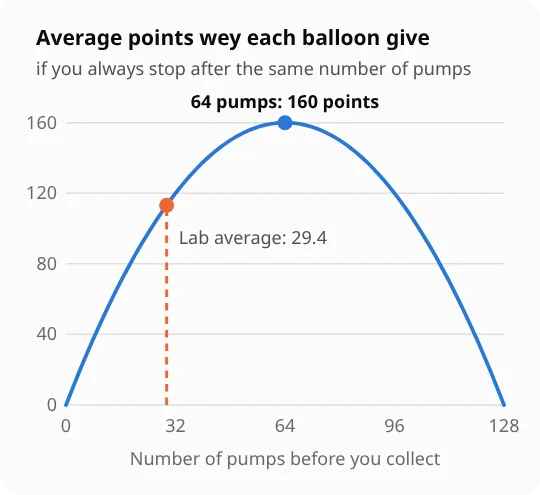
If you stop every balloon at the same number of pumps, 64 pumps go earn the most points on average. Most people dey stop much earlier: for the original study, 86 young adults average 29.4 pumps on balloons wey dem collect [1]. To pump less dey safer, so no correct answer dey; na choice between two things.
Cite dis page: Balloon Risk Game. Helibrain. 2026. https://helibrain.com/pcm/balloon-risk-game. CC BY 4.0.
Quick facts
- Wetin e dey measure: risk-taking when each extra step dey pay small and fit cost you everything. Na Balloon Analogue Risk Task (BART) be this, and dem first publish am for 2002 [1].
- Usual value: for the original study, adjusted average na 29.4 pumps, and the difference between people na 13 (one standard deviation). Men pump pass women on average [1].
- E dey stay steady over time: for 39 adults wey play two times with about 12 days between, the scores correlate at r = .77 [2].
- Connection with everyday life: for 2002, people wey pump more report say dem dey gamble, smoke and do other risky things more [1]. One review of 22 studies with 2,120 people later find say connection with sensation seeking and impulsivity questionnaires small only [3].
How the game dey work
- Pump. Every pump add 5 points to the balloon wey dey front of you. The balloon go grow.
- Collect any time wey you like. The balloon points go join your total, and the next balloon go show.
- If e burst first, you go lose the points for that balloon. Every balloon get different hidden time wey e go burst.
You go play 30 balloons. Like the original task, any balloon fit burst from the first pump reach the 128th pump, and every point get the same chance, so the average burst point dey for the middle [1].
The original study use 90 balloons with three colours and pay real money, 5 cents for each pump; the main score come from the 30 balloons wey get 128-pump limit, na that version you dey play here [1]. Researchers don use from 10 reach 90 balloons [2]; for the original study, scores from the first 10 balloons or last 10 balloons lead to the same conclusions [1].
Wetin fit affect your score
- Learning. Plenty people dey pump more as the game dey go on, after dem see how far balloons fit go [1].
- The stakes. Lab versions pay real money; this game use points, so your choices fit bold pass or careful pass wetin you go choose with cash.
- Knowing the maths. If you read Figure 1 before you play, e go change your choices. Play first, then read.
Wetin this game fit and no fit tell you
This game show how you balance risk and reward across 30 balloons, today. E no be personality test, and e no fit tell you whether you dey take risks with money, health or driving: the connection between this task and real-life habits small [3]. E no talk anything about your health and e no be diagnosis.
Our version near the one wey dem publish, but you no fit compare the scores strictly with lab studies: dem pay money, use different number of balloons and test small groups of students [1][2]. Compare your score with other players here and with your own later plays.
Questions people dey ask
Wetin be Balloon Analogue Risk Task?
Balloon Analogue Risk Task (BART) na computer game wey dem publish for 2002 by Lejuez and colleagues to measure risk-taking. Every pump dey blow up balloon and earn small money; when you collect am, dem add am to your total; if e burst, you lose am. The score na average number of pumps for balloons wey no burst [1].
Wetin be good score for balloon game?
For Helibrain balloon game, no good or bad score dey. If you pump 64 times for every balloon, you go earn the most points on average, but about half of the balloons go burst too. For the original study, young adults average 29.4 pumps for balloons wey dem collect [1].
If I pump more, e mean say I dey take risk for real life?
E no must mean so. For the original study, people wey pump more report small increase for gambling, smoking and drinking [1]. But one review of 22 studies find say connection between the task and questionnaires about sensation seeking and impulsivity small only [3]. Your balloon score describe this game, no be your life.
Why balloon wey burst no dey count for my average?
When balloon burst, e stop the count early, so e go hide how far you plan to go. Na why BART main score, the adjusted average, use only balloons wey you collect. Helibrain balloon game follow the original study for this [1].
Helibrain balloon game really free?
Yes. Helibrain balloon game and your full result dey free: no sign-up, no email, no payment. Helibrain dey make money from its app, wey get free plan and paid plans; you no need the app to play.
Other tests wey relate to am
- Card game with 4 decksHow quick you learn which choices dey pay when the rules dey hidden.
- Guess 2/3 of di averageHow many steps ahead you dey think about wetin everybody else go guess.
- Go/no-go testWhether you fit stop yourself from tapping on time.
See all di 43 free tests wey check brain
You wan work on dis every day? Di Helibrain app (for English for now) get free plan and plans wey you pay for.
Cite dis page: Balloon Risk Game. Helibrain. 2026. https://helibrain.com/pcm/balloon-risk-game. CC BY 4.0.
How this test works
This game looks at how you balance risk and reward. Each pump adds 5 points to a balloon, and you can collect its points at any time. But every balloon bursts at a hidden point, and a burst loses that balloon's points. You play 30 balloons. Your main score is the average number of pumps on the balloons you collected. There is no right answer, only a trade-off. Psychology labs have used this balloon task to look at risk taking since 2002.
Version 1 · Cite this test:
Helibrain (2026). Balloon risk game, v1. https://helibrain.com/balloon-risk-game/methods
Sources
- Lejuez CW, Read JP, Kahler CW, Richards JB, Ramsey SE, Stuart GL, Strong DR, Brown RA (2002). Evaluation of a behavioral measure of risk taking: the Balloon Analogue Risk Task (BART). Journal of Experimental Psychology: Applied 8(2):75–84. doi.org/10.1037/1076-898X.8.2.75
- White TL, Lejuez CW, de Wit H (2008). Test-retest characteristics of the Balloon Analogue Risk Task (BART). Experimental and Clinical Psychopharmacology 16(6):565–570. doi.org/10.1037/a0014083 (free full text: pmc.ncbi.nlm.nih.gov/articles/PMC4244869/)
- Lauriola M, Panno A, Levin IP, Lejuez CW (2014). Individual differences in risky decision making: a meta-analysis of sensation seeking and impulsivity with the Balloon Analogue Risk Task. Journal of Behavioral Decision Making 27(1):20–36. doi.org/10.1002/bdm.1784
How we take make dis page: di Helibrain team write am from di studies wey dem list above, and Robert(English) (PhD student for biophysics) review am on 4 Nọvẹ́mba 2026. We dey update am wen di sources change.